Class 01 — What AI Is (and First Hands-On Use)
Date: Thursday, Sept 17, 2026
Objectives
Section titled “Objectives”- Explain artificial intelligence in accessible language.
- Describe how a learned model works: trained on huge amounts of data, predicting what comes next.
- Distinguish AI from rule-following programs — a calculator, a game NPC — and from a search engine.
- Recognize the three big myths: AI knows everything, AI is always correct, AI thinks like a human.
- Complete a first supervised prompt — after passing the task through the Seven-Question Check.
Our class framework: The Seven-Question AI Check
Section titled “Our class framework: The Seven-Question AI Check”We ran Class 1 around this diagram, and every class after it uses the same tree. If you cannot answer YES at any point, skip AI for the task.
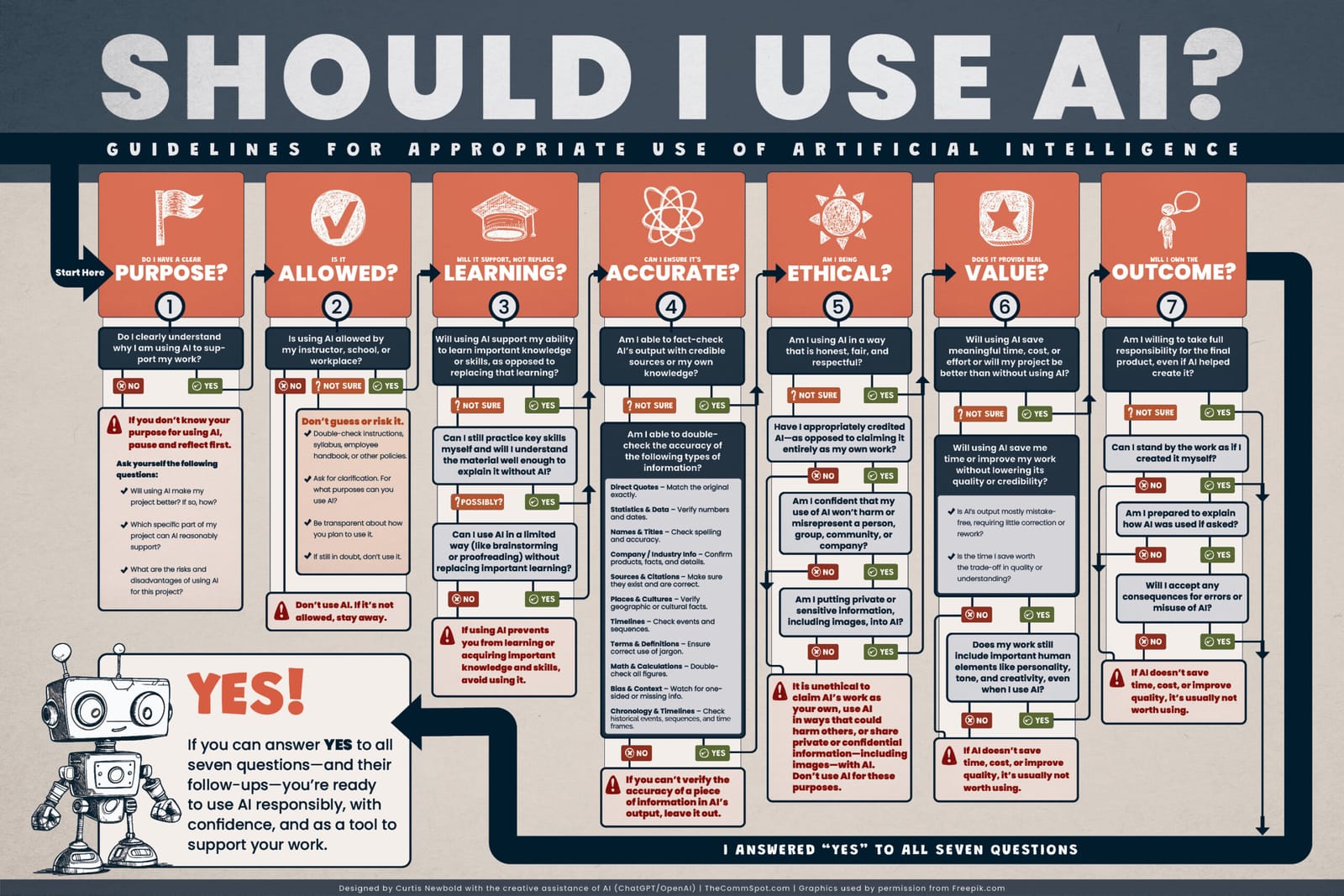
Adapted from Curtis D. Fry, “Should I Use AI? A Visual Guide for the Appropriate Use of Artificial Intelligence” (The Comm Spot). The full question-by-question table is in the Syllabus, and the poster and credit-where-due links are on the Resources page.
What is AI? The basics
Section titled “What is AI? The basics”In one sentence
Section titled “In one sentence”AI is a machine that learned patterns from so much data that it can predict what comes next — the next word, the next pixel, the next move.
How does a model actually work?
Section titled “How does a model actually work?”- Training: the system is shown an enormous amount of text (and images, game moves, …) and slowly tunes billions of internal “knobs” until it gets very good at predicting what comes next.
- A model is the learned patterns, not a database of answers. When it answers you, it isn’t looking something up — it’s generating a fresh response from what it learned.
- That design is its power and its flaw: it can handle questions nobody anticipated, and when it doesn’t actually know, it fills the gap with something that sounds right. Confident nonsense is built into how it works — Class 2 explores that more.
- Everything that exists today is narrow AI: brilliant at one kind of task, blind to the rest. Human-level-everything AI (AGI) does not exist yet, no matter what the marketing says.
How is this different from a calculator or a game NPC?
Section titled “How is this different from a calculator or a game NPC?”A calculator and an NPC are programs following rules a human wrote. An AI model is a pattern that was learned — nobody typed the answers in.
| Calculator | Game NPC | AI model (ChatGPT & friends) | |
|---|---|---|---|
| Where its behavior comes from | Every rule written by a programmer | Every line of dialogue scripted by a writer | Learned from massive data — no one wrote the answers |
| Can it surprise you? | No — same input, same output | No — it repeats its script | Yes — it generates, it doesn’t retrieve |
| Can it be wrong? | Never at 2 + 2 | Never “wrong” — just stuck walking into a wall | Yes — confidently wrong (that’s a hallucination) |
| Good for | Following rules exactly | Simple, predictable responses | Language, images, fuzzy pattern-matching |
AGI and game NPCs are mentioned here in passing only — we don’t chase either this term.
Agenda (60 min)
Section titled “Agenda (60 min)”| Time | Block |
|---|---|
| 0–5 | Welcome + how the course works (prompt log, weekly warm-up) |
| 5–20 | Mini-lesson: what AI is, how a learned model works, and how it differs from rule-following programs (calculator, NPC) and from search engines — the table above |
| 20–30 | Game: AI, algorithm, or human? Students classify examples and explain their reasoning. |
| 30–35 | First contact rule: before anyone types a prompt, they state their purpose in one sentence and run it through the Seven-Question Check (Questions 1 and 2 especially), using the diagram above. |
| 35–55 | First hands-on use: each student asks the class tool one school-relevant question; share one surprising output. |
| 55–60 | Exit ticket: one thing AI is, one thing AI is not. |
What we actually covered (Sept 17)
Section titled “What we actually covered (Sept 17)”The record of the first class, from the session notes:
Machine learning → today’s LLMs
Section titled “Machine learning → today’s LLMs”Where current models came from — the short history we walked through:
- The old way: hand-written rules. Classic software is a recipe — a human programmer writes every rule. That’s why a calculator can’t bend its rules and an NPC keeps walking into the wall: it can only do what someone coded.
- The machine learning idea: stop writing the rules — learn them. Feed a system lots of examples and let it tune its own settings until it finds the patterns. Spam filters and movie recommendations are this idea in everyday use.
- Neural networks & deep learning: the same idea scaled up — many layers of simple trainable “knobs”, fed ever more data and compute. This is what made machines suddenly good at images, speech, and game-playing.
- LLMs = deep learning applied to language at web scale. Train on an enormous pile of text to predict what comes next, and you get ChatGPT & friends.
The fit in one line: an LLM is machine learning all the way up — nobody wrote it rules, it learned patterns from nearly everything we’ve typed. That’s why LLMs act like pattern-predictors, not fact databases.
Also covered
Section titled “Also covered”- Live demo, live lesson. We asked the AI a hyper-local question (which sermon a pastor preached on a given Sunday). It searched the web, grabbed the what it found first, which was not what we had meant. First-hand proof that every fact, quote, statistic, and citation it gives you needs human verification.
- Support, don’t replace. AI is good for brainstorming, proofreading, and grammar checks; it’s bad at doing the practicing, the learning, or the original work for you — those are the parts that build the skill.
- Privacy. Your conversations are stored on the company’s servers. Never type your address, phone number, or “I live near hometown…” details into a prompt.
- Accountability. If you use AI, you own what comes out: be able to explain how you used the tool, and stand behind the work even when it contains an error.
- Economics and hype. Big models need enormous memory to run — the “RAM crisis” — so expect prices and product limits to keep moving. Much of the scary talk (“AI escaped!” “AI was hacked!”) is marketing, not reality.
Key terms
Section titled “Key terms”- Narrow AI vs. AGI — everything that exists today is narrow.
- Pattern recognition / prediction — what the models actually do.
- Machine learning — the precursor idea behind LLMs: learn patterns from data instead of hand-writing rules; scaled up via neural networks and deep learning into today’s models.
- Training data — what a model learned its patterns from.
- Rule-based program — a calculator or NPC: behavior written by a human, never learned.
- Hallucination — confident nonsense; preview only, Class 2 goes deep.
Seven-Question connection
Section titled “Seven-Question connection”Q1 (clear purpose) — the first-contact rule makes students name the role AI plays before they ever type. Q2 (allowed) — we stated the classroom access rules out loud on day one. In Class 1 we touched all seven through the diagram; each one gets its full unit later in the syllabus table.
Homework / log entry
Section titled “Homework / log entry”Bring one example this week of something you suspected was AI-generated (text, image, video, or a weird ad). Next class starts with the warm-up on these. Optional but encouraged: bring a laptop to Class 2.